Posted on October 06, 2026 by Fusion Connect
Every business has a disaster plan.
There may be an evacuation route taped to a breakroom wall. A call tree in a shared folder. Or may be a binder somewhere with laminated pages, tabbed sections, and the quiet confidence of a document nobody wants to need.
But when an emergency happens, the plan depends on something less dramatic and much easier to overlook:
Can people still communicate?
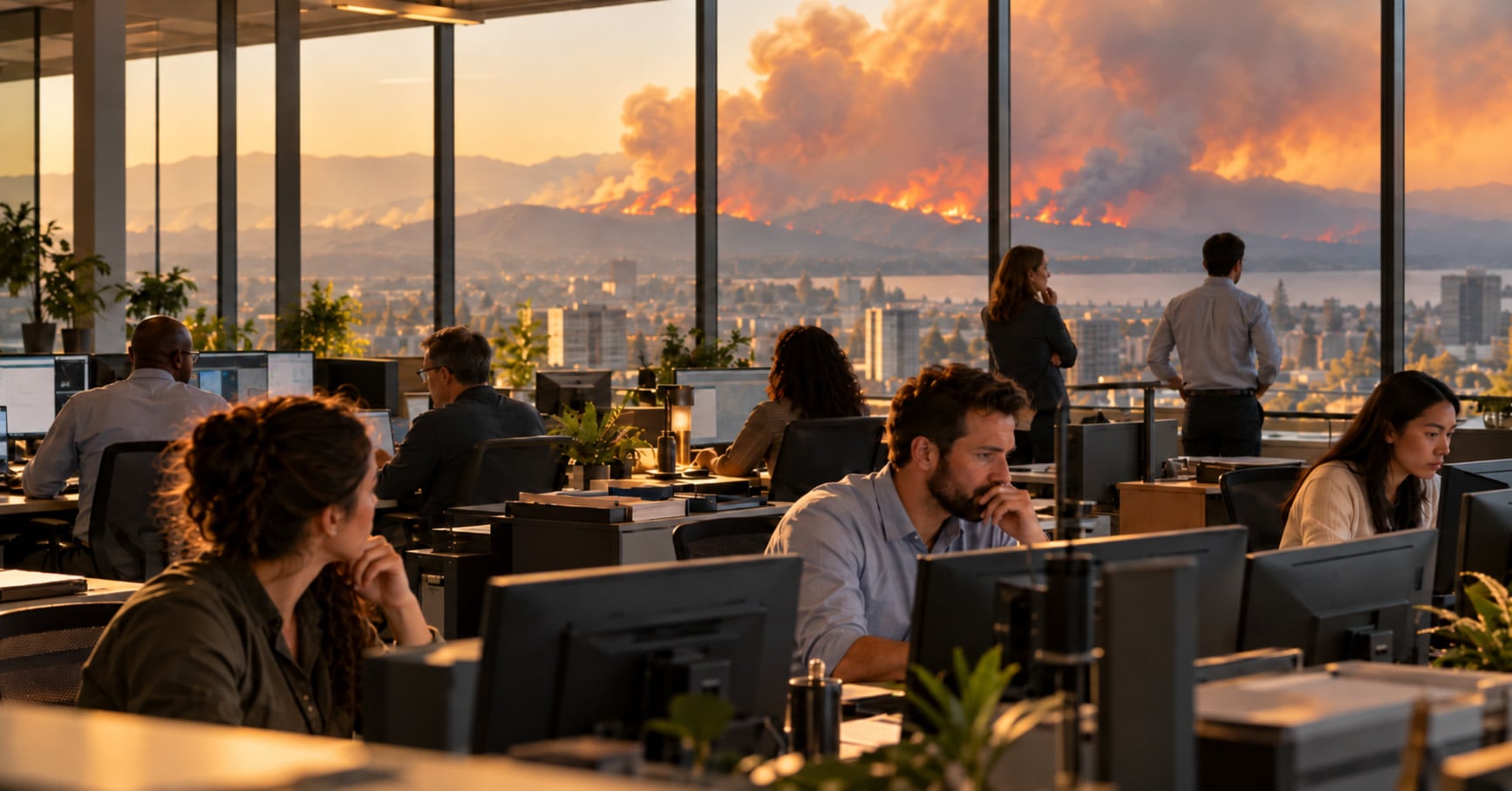
Wildfires move quickly. Smoke affects travel. Power becomes unstable. Offices close. Employees work from somewhere else. Customers need updates. Branch locations need direction. Leaders need visibility into what is still online, what has failed, and what needs attention first.
In those moments, connectivity is not just an IT concern. It becomes part of the emergency plan.
The real business problem: disruption rarely stays in one lane
A wildfire may begin as a local threat, but the business impact spreads across teams, systems, and locations.
One office needs to close. Another stays open but loses reliable internet. Employees shift to remote work with little notice. Contact center volume increases as customers call for updates. A branch redirects calls. A manager needs to know whether network equipment is still online. Field teams need mobile access to applications, schedules, and customer information.
The challenge is not only the fire itself. It is everything that needs to keep working around it.
That includes internet access, phones, routing, customer communications, cloud applications, security, network visibility, and support.
When those systems are planned separately, emergency response becomes harder than it should be.
What breaks first
Every business is different, but during a regional emergency, weak points tend to show up fast.
- Internet connectivity becomes unreliable.
If a site depends on one connection, one outage can interrupt payments, customer service, cloud applications, phone systems, and daily operations. - Voice services need to move quickly.
Customers may still call the main number, even if the office behind that number is closed or short-staffed. - Remote access will be tested all at once.
Employees who normally work onsite suddenly need secure access from home, temporary locations, or mobile devices. - Customer updates become harder to manage.
People need to know whether locations are open, appointments are changing, support teams are available, or services are delayed. - IT visibility is limited.
Without network monitoring, teams do not know whether a site is down, degraded, or still functioning until someone reports a problem. - Analog lines may still play a critical role in your business.
Fire alarms, security systems, elevator phones, fax workflows, gates, and other legacy devices may depend on services that are easy to forget until they become urgent. - Security remains important during emergencies.
During disruptions, users connect from new locations, networks, and devices. The business still needs to protect access to applications, data, and systems.
The emergency may be physical but the response is operational.
What a stronger wildfire readiness plan includes
A strong plan starts by looking at the systems people rely on when conditions change quickly.
- Backup connectivity
Businesses should understand which locations need backup internet access and which applications are critical enough to require failover planning.
Backup connectivity supports continuity when a primary connection becomes unstable or unavailable. For multi-location businesses, that means reviewing the needs of each site rather than assuming every location carries the same risk.
- SD-WAN and traffic management
SD-WAN helps businesses manage traffic across multiple connections, prioritize critical applications, and support better performance when network conditions change.
During a wildfire disruption, that matters for voice, cloud applications, customer service tools, payment systems, and collaboration platforms.
- SASE and secure access
When employees shift locations, security has to move with them.
When employees shift locations, security has to move with them.
SASE brings networking and security together so users securely access business applications from offices, branches, remote locations, and wherever work needs to happen.
That matters when the normal office perimeter is no longer the center of work.
- Network monitoring
Leaders and IT teams need visibility during disruption.
Network monitoring helps teams understand site health, equipment status, circuit performance, and potential issues before they become larger problems. That visibility helps teams prioritize response instead of guessing which location needs attention.
- Cloud voice and call routing
Customers may not know or care which office is affected. They call the number they know.
Cloud voice, hosted voice, SIP trunking, Microsoft Teams Calling, and contact center routing redirect calls, support remote agents, and keep customer communication moving when a location is unavailable.
- SMS/MMS business texting
During disruption, a phone call may not be the fastest way to reach customers, employees, or field teams.
Business texting can help organizations send updates about closures, service changes, appointment adjustments, or next steps. It also gives customers another way to communicate when call volume rises.
- POTS replacement planning
Some of the most important emergency-related devices may still be tied to analog lines.
POTS replacement planning can help businesses identify legacy lines used for alarms, elevators, security systems, fax, gates, paging, and other specialized needs. That work is easier to manage before an emergency forces the question.
One support path
When something breaks during an emergency, businesses shouldn’t have to spend valuable time figuring out which vendor owns which part of the problem.
A stronger plan includes clear ownership across connectivity, voice, security, customer communications, and support.
Where Fusion Connect fits
Fusion Connect helps businesses look at emergency preparedness across the full suite of services that keep teams, locations, and customers working.
That matters because wildfire readiness is not only about one product. It is about how the pieces work together.
A business may start with backup internet access, then realize it also needs SD-WAN, SASE, network monitoring, hosted voice, Microsoft Teams Calling, contact center support, business texting, or POTS replacement. Another may begin with voice continuity and discover that its network needs better failover, visibility, or security.
Fusion Connect can help businesses evaluate those dependencies and build a more practical plan across connectivity, communications, customer engagement, cloud, security, and support.
The goal is simple: help the business keep moving when conditions are anything but simple.
Break glass before the emergency
Nobody wants to build a wildfire response plan while the sky outside is already glowing orange.
The better time to prepare is before the disruption arrives.
Start by identifying the locations, applications, phone numbers, customer channels, analog lines, and support paths your business depends on. Then look at where a single outage, closed office, overloaded contact center, or unsupported device could create risk.
The emergency plan shouldn’t stop at evacuation routes and contact lists. It should include the communications and connectivity systems people rely on when the plan becomes real.
Speak to Our Tech Experts
Reach out to Fusion Connect before the emergency plan becomes the emergency.